
+91 7075 919 685
Beyond the Resume: What Great Hiring Really Looks Like

Beyond the Resume: What Great Hiring Really Looks Like

In today’s dynamic job market, hiring can’t rely solely on resumes and qualifications. While experience and credentials matter, they only tell part of the story. Great hiring goes deeper — it’s about identifying the right person for the role, the team, and the culture. Modern recruitment calls for a more holistic, thoughtful approach. HR professionals today are not just filling roles; they’re shaping the future of their organizations. Here’s what truly effective hiring looks like — and what skills recruiters need to do it well.

1. From Checklist to Character: Rethinking What “Qualified” Means

Too often, hiring decisions start with a rigid checklist: certain years of experience, specific degrees, or exact software skills. But that narrow view can cause you to miss great candidates — especially those who bring diverse perspectives or have transferable skills from other industries.

What matters more is how someone thinks, solves problems, and adapts. Great recruiters look beyond bullet points to uncover potential. They focus on a candidate’s learning agility, values, and communication style — because those qualities often determine long-term success more than credentials do.

2. Behavioral Interviewing: Listening for Impact

Resumes say what someone has done. Behavioral interviews help uncover how they did it — and why it matters.

Asking thoughtful, open-ended questions (“Tell me about a time when…”) reveals how a candidate handles pressure, conflict, teamwork, and leadership. But the key isn’t just asking — it’s actively listening. What do they emphasize? What do they skip? How do they describe collaboration or failure?

This skill helps HR professionals make more human, nuanced hiring decisions that align better with real-world job demands.

3. DEI-Conscious Hiring: Removing Bias, Expanding Talent

Diversity, equity, and inclusion (DEI) isn’t just a buzzword — it’s a business strength. Great hiring prioritizes fairness at every stage of the process, from writing inclusive job descriptions to using structured interviews that reduce unconscious bias.

Building diverse interview panels, applying consistent evaluation criteria, and using anonymized screening tools can all help make hiring more equitable. It’s not about lowering standards — it’s about expanding opportunity and focusing on true potential.

4. Candidate Experience: Your Reputation Is on the Line

Every interview is a two-way street. Candidates aren’t just being evaluated — they’re evaluating your organization. A clunky process, poor communication, or lack of respect can turn even strong candidates away.

Great hiring ensures a positive, professional experience for every applicant, whether or not they get the job. That means clear timelines, respectful feedback, and treating people like people — not numbers. In a competitive talent market, your candidate experience is part of your employer brand.

Final Thoughts: Hiring as a Strategic Advantage

Great hiring is intentional. It’s guided by curiosity, fairness, and a clear understanding of what success really looks like in a role. When HR professionals master the skills of modern recruitment — from behavioral interviewing to DEI-conscious evaluation — they don’t just fill positions. They build stronger teams, reduce turnover, and help their companies thrive.

Because at the end of the day, it’s not just about finding someone who can do the job — it’s about finding someone who will grow with it.

 

Beyond the Resume: What Great Hiring Really Looks Like

HR Is Not Just a Department. It’s the Heartbeat of Culture.

When people think of HR, they often think of policies, hiring, or payroll. But those who’ve worked closely with a great HR team know the truth: HR isn’t just a department — it’s the emotional rhythm of an organization. From a new hire’s very first “welcome aboard” email to the final moments of an exit interview, HR is there — listening, guiding, and setting the tone. And in between those milestones, they’re shaping something deeper: culture.

The Quiet Influence That Builds Belonging

Culture isn’t built in one meeting or declared in a company handbook. It’s built in the everyday actions that signal what matters: how people are treated, how feedback is given, how conflict is handled, and how decisions are made. And much of that is either led by — or shaped with — HR.

They’re the ones:

  • Designing onboarding experiences that help new hires feel safe and seen
  • Creating fair, inclusive policies that reflect company values
  • Leading wellness initiatives that show care goes beyond words
  • Handling tough conversations with empathy, discretion, and integrity

HR professionals set the emotional temperature of the workplace — not by force, but by consistent, thoughtful presence.

 Protectors of People and Principles

When things get hard — a restructure, a misconduct case, a drop in morale — HR often carries the emotional weight of the organization. They’re the bridge between people and leadership, and they must protect both sides.

This balance is never easy. But it’s in these moments that HR’s influence becomes most clear: they help organizations walk the line between business and humanity. They remind decision-makers that values matter. They advocate for fairness, transparency, and dignity — even when it’s uncomfortable.

And often, they do it behind the scenes.

 Culture Doesn’t Just Happen. HR Builds It.

Strong workplace cultures don’t emerge by accident. They’re built with intention. And HR is often the architect — shaping it conversation by conversation, policy by policy, person by person.

They build trust not just through what they say, but how they show up. They create consistency. They hold the mirror up when needed. They remind people — especially during busy or stressful times — what the company stands for.

A Quiet Tribute to a Loud Impact

So here’s to the HR professionals who stay late after layoffs to support managers.
To the ones who celebrate work anniversaries most people forget.
To those who answer hard questions with grace — and ask harder ones when no one else will.
HR may not always be in the spotlight. But they are, without question, the heartbeat of workplace culture.

And the pulse of a great company always starts there.


Beyond the Resume: What Great Hiring Really Looks Like

The Humans Behind Human Resources

Human Resources professionals are often seen as neutral, polished, and always composed. They’re the ones who know the rules, guide the process, and offer support with calm professionalism. But behind every policy written, every meeting led, and every difficult conversation held — there’s a person.
A real human being. With emotions. With boundaries. With a story of their own.

And yet, somehow, HR is rarely allowed to show that side.

The Expectation: Be Calm, Be Fair, Be Unshakeable

HR is often expected to be the steady hand in the storm — to walk into any situation, no matter how emotionally charged, and manage it with grace. They’re the ones others go to when something feels unfair, unsafe, or overwhelming.

They are asked to:

  • Deliver difficult news with empathy
  • Stay composed during conflict
  • Represent both the employee and the company
  • Absorb others’ frustrations, sadness, and stress

But in doing all of that… who’s checking in on them?

The Reality: Quiet Emotional Labor

Many HR professionals carry unseen emotional loads.

They’re the first to know about layoffs and the last to process them emotionally.
They’re expected to comfort others — but rarely given space to grieve themselves.
They often listen to what hurts in others, while holding back their own hurt.

It’s not that HR lacks strength — it’s that their strength is often mistaken for invincibility.

HR Deserves Humanity Too

It’s time to recognize that HR professionals are not just function-holders. They’re people.

People who want to be included in wellness initiatives — not just roll them out.
People who need a safe space to process heavy conversations.
People who feel deeply — and care immensely — about the people they serve.

Being “human” in Human Resources should be a strength, not a liability. Vulnerability doesn’t diminish professionalism — it enhances trust, empathy, and connection.

How Organizations Can Help

Here’s how companies can better support the humans behind HR:

  • Create safe peer spaces where HR professionals can reflect and recharge
  • Acknowledge emotional labor as part of the workload
  • Invest in mental health and resilience tools for HR — not just employees
  • Normalize care and support flowing back to HR, not just through them

Because when HR is supported, they’re even better at supporting everyone else.

Final Thought

HR is more than processes and policies. It’s people. People who often choose this work because they care deeply about others. So the next time you talk to someone in HR — pause for a moment. Ask how they’re doing. Listen with the same care they offer you.

Because behind every decision, every strategy, and every spreadsheet…
There’s a human. And they deserve just as much grace as they give.


The Weight HR Carries (That No One Talks About)

The Weight HR Carries (That No One Talks About)

HR professionals are known for being composed, fair, and dependable. When conflict arises, HR is called in. When teams struggle, HR listens. When layoffs or discipline must happen, HR delivers the message. But beneath that professionalism is something we don’t talk about enough: the quiet emotional weight HR carries.

The Invisible Load

HR is the department that holds space for others — not just in meetings or performance reviews, but in some of the hardest moments employees face. Grief, burnout, conflict, mental health struggles, unfair treatment, restructuring, job loss — HR sees it all. And often, they are expected to stay strong for everyone else. It’s easy to forget that behind that support is a person who also feels.

The emotional labor of HR is real, but it’s rarely named. Unlike clinical roles like therapists or counselors, HR doesn’t have built-in spaces to process the emotional toll. And yet, they regularly serve as the workplace equivalent of emotional first responders.

The Pressure to Stay Neutral

One of the most difficult challenges HR professionals face is the expectation to always remain neutral. They must be firm, but kind. Empathetic, but objective. Supportive, but compliant with policies. And while doing this, they often suppress their own reactions, feelings, or fatigue — because the job asks for composure above all.

Over time, this pressure builds into something else: compassion fatigue. It’s a quiet burnout that doesn’t scream for attention — it just erodes your sense of emotional energy.

Burnout Doesn’t Look the Same for Everyone

When HR professionals burn out, they might not withdraw or shut down. Instead, they might:

  • Start questioning whether they’re actually helping anyone
  • Dread conversations that used to inspire them
  • Feel alone in rooms where they’re supposed to be “the fixer”
  • Lose the spark that made them want to work with people in the first place

And because HR is seen as the support system, few people think to ask: “Are you okay?”

Let’s Change That

It’s time for organizations to recognize that HR needs support, too. That includes:

  • Emotional wellness programs specifically designed for HR
  • Peer spaces to debrief heavy conversations
  • Permission to feel — not just perform
  • Leaders who model compassion for everyone, not just the frontline

The HR team might be the emotional backbone of your workplace. But even backbones need rest, strength, and care. Let’s stop pretending HR is made of stone. They’re human — and they’re carrying more than most people realize.

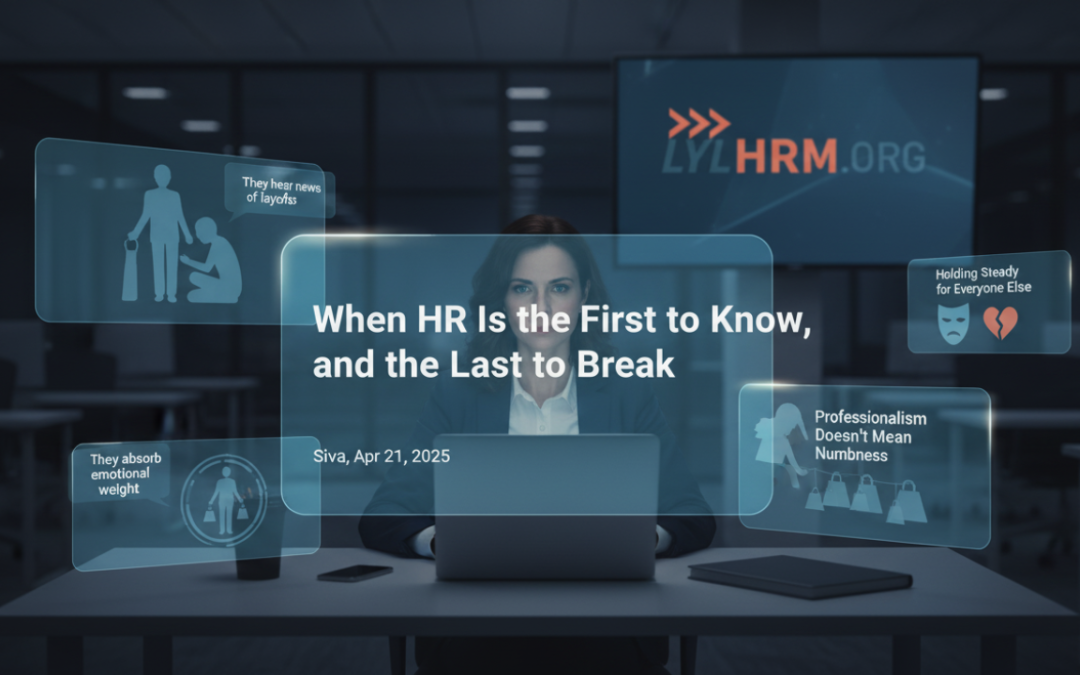
 When HR Is the First to Know, and the Last to Break

 When HR Is the First to Know, and the Last to Break

In every company, HR is often the first to know — and the last allowed to react.

They hear the news of layoffs before anyone else.
They receive complaints and confessions employees are scared to share.
They absorb emotional weight long before it becomes public.

And yet, they must stay composed, professional, and emotionally available for everyone else.

The Weight of Knowing Too Much, Too Soon

HR professionals sit in a unique space — privy to what’s coming, while expected to act as if everything’s normal.

They may know that someone’s job is at risk, yet still greet them with warmth.
They may hear personal struggles from employees, while juggling business pressures from above.
They may spend all day tending to others — then carry that emotional load home.

What’s most remarkable? They do it without letting it show.

Holding Steady for Everyone Else

HR’s job isn’t just about policies. It’s about emotional containment.
It’s about being a safe space for everyone else, even when no one offers them the same in return.

They walk into hard meetings with a calm voice.
They mediate tension while staying neutral.
They help others process feelings — but often suppress their own.

This isn’t just professionalism.
It’s a kind of silent strength that most people overlook.

Professionalism Doesn’t Mean Numbness

Let’s be clear: HR feels.

They feel the pain of letting someone go.
They feel the discomfort of navigating ethical gray areas.
They feel the pressure of being expected to always “do the right thing” — even when it’s hard to define what that is.

But they don’t get the luxury of breaking down.
They support others, and then quietly return to their desks, carrying it all.

Let’s Honor the Ones Who Hold It All Together

This blog isn’t just a reflection. It’s a recognition. To every HR professional who shows up, stays strong, and holds space when no one else will — thank you.

You may be the first to know.
You may be the last to break.
But you are also the one who keeps the company human.